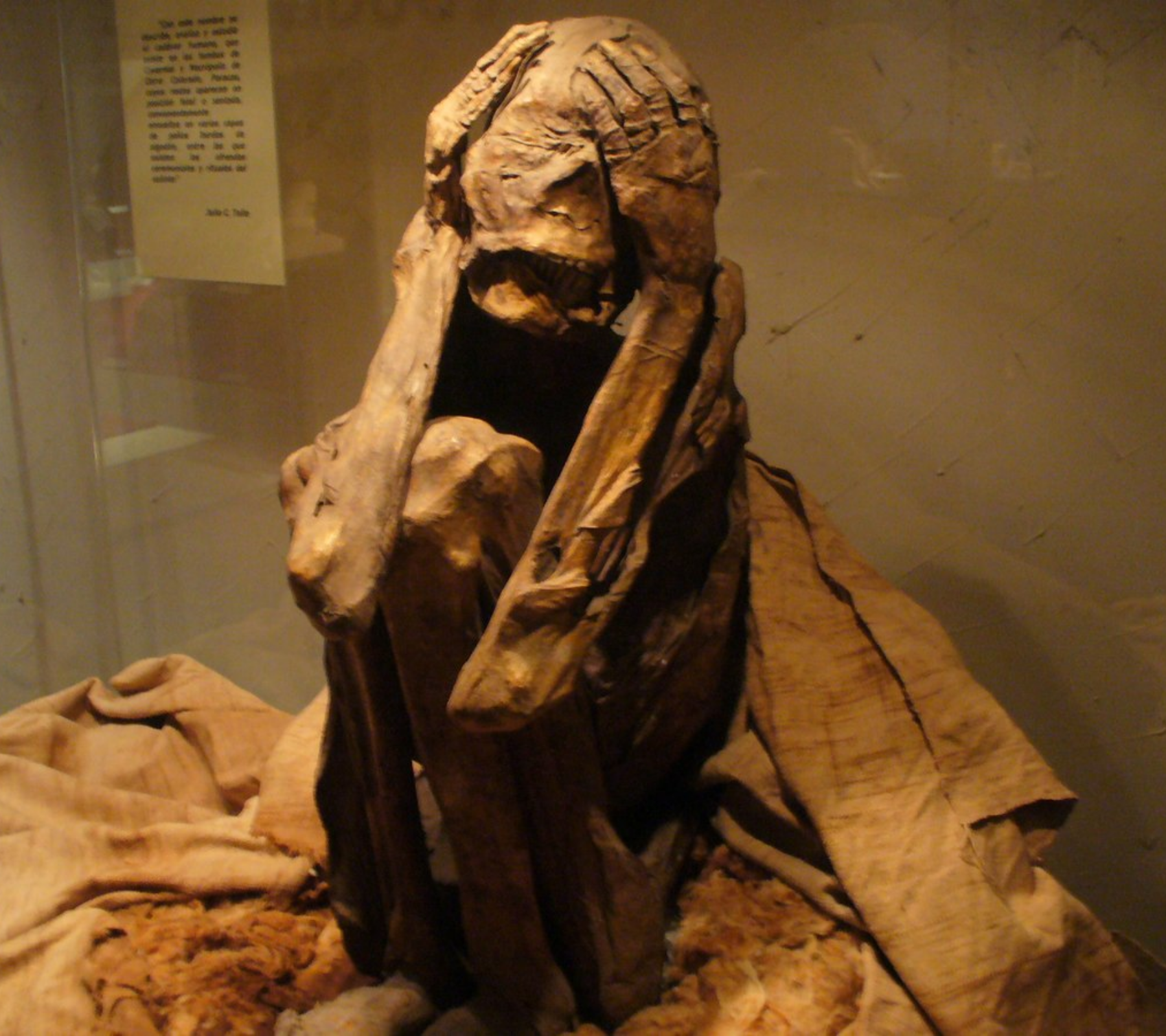
The museum was inaugurated in 1996 and exhibits cultural artifacts from archaeological excavations at the Wari monumental archaeological zone: ceramics, lithics, textiles, monoliths, among others; as well as explanatory texts about the Wari culture, a map, and photographs of the different sectors within the site.
Description
The Wari Archaeological Complex was a pre-Hispanic capital city belonging to the Wari culture and is the most complex expression of Andean urbanism. It is worth mentioning that the Wari civilization was a political and social state that emerged between 550 and 900 CE. The first mention of the site comes from the chronicler Pedro Cieza de León, who in the mid-16th century described it, giving it the name Viñaque. It became the urban capital of a powerful military state that conquered a vast empire six centuries before the Incas.
Wari was the capital of the first Andean Empire, which flourished during the Middle Horizon, extending as far north as Cajamarca and as far south as Tacna. A significant achievement of the Middle Horizon was the emergence of the city as the most complex and advanced expression of Andean urbanism. This urbanism crystallized with Wari, which would later influence the concepts, patterns, and technologies of both the Late Intermediate Period (Chimú) and Inca cultures. The Wari monumental archaeological zone encompasses a vast area with monumental remains, consisting of an urban center—the most prominent of the complexes—and an immediate peripheral area. It is estimated that its population ranged from 50,000 to 70,000 inhabitants and it possessed a complex and efficient water supply system from the Yanaqocha lagoon, supplied by a 25-kilometer-long trapezoidal canal, part of which is still in use today.
The monumental area comprises the central part of the complex and is also the area open to tourists. It covers a quadrangular area of almost 302 hectares. It has a moderate east-west slope, with altitudes ranging from 2,645 to 2,800 meters above sea level. The sectors that make up the monumental area are delimited by large trapezoidal walls that enclose a series of smaller structures of varying shapes, sizes, and functions, connected by alleyways, corridors, courtyards, terraces, and various circulation areas. Most of them, primarily in the lower part, are buried, while those in the upper part remain exposed. Their architectural layout clearly demonstrates urban planning. The perimeter walls of some sectors, such as Uchpa-Qoto and Capillapata, reach heights exceeding eight meters above the current ground level. They feature expansion joints and horizontal segments at regular intervals and heights, to which smaller structures with vertical walls are attached, some with projecting stones as if to support beams for two or three stories above ground.
There are also multi-level underground buildings. The walls of the city's main civil, religious, and administrative buildings must have been plastered and painted white and red. One of the architectural forms that characterizes the urban layout and is associated with the city's orthogonal pattern is the D-shaped structure, visible in the Sullu Cruz, Capillapata, Vegachayoc Moqo, Monqachayoc, and Cheqo Huasi sectors. Another cultural element that helps to define the extent of the Wari urban area is rock art, manifested in petroglyphs and circular pits carved into various stones and rock outcrops located on the periphery of this area. The Wari Archaeological Complex is ideal for those interested in the history of ancient Peru. It also features a site museum exhibiting cultural artifacts from archaeological excavations in the Wari monumental archaeological zone: ceramics, lithics, textiles, monoliths, and more.
Characteristics
Currently, with its 2,000 hectares, it is considered the largest archaeological zone in the Peruvian highlands. It had a hierarchical structure with power groups that gradually built large structures of stone joined with mud mortar, where rulers, priests, military personnel, artisans, and the common people settled. The criteria for classifying Wari as a city are based on its large size and high population density, its complex internal, daily, and public organization, and finally, its strategic position in the state's geopolitics, as supported by the Wari Archaeological Complex Management Plan, Ayacucho 2010; written by L. G. Lumbreras Salcedo, Consultant for the National Institute of Culture, and others.
Current state
Good, because the different architectural structures located in the sectors of Vegachayocc Moqo, Capillapata, Monqachayocc and Cheqo Huasi are in a good state of conservation and clearly show their structural elements. Additionally, the archaeological zone is protected with permanent surveillance and periodic cleaning by the Ministry of Culture.