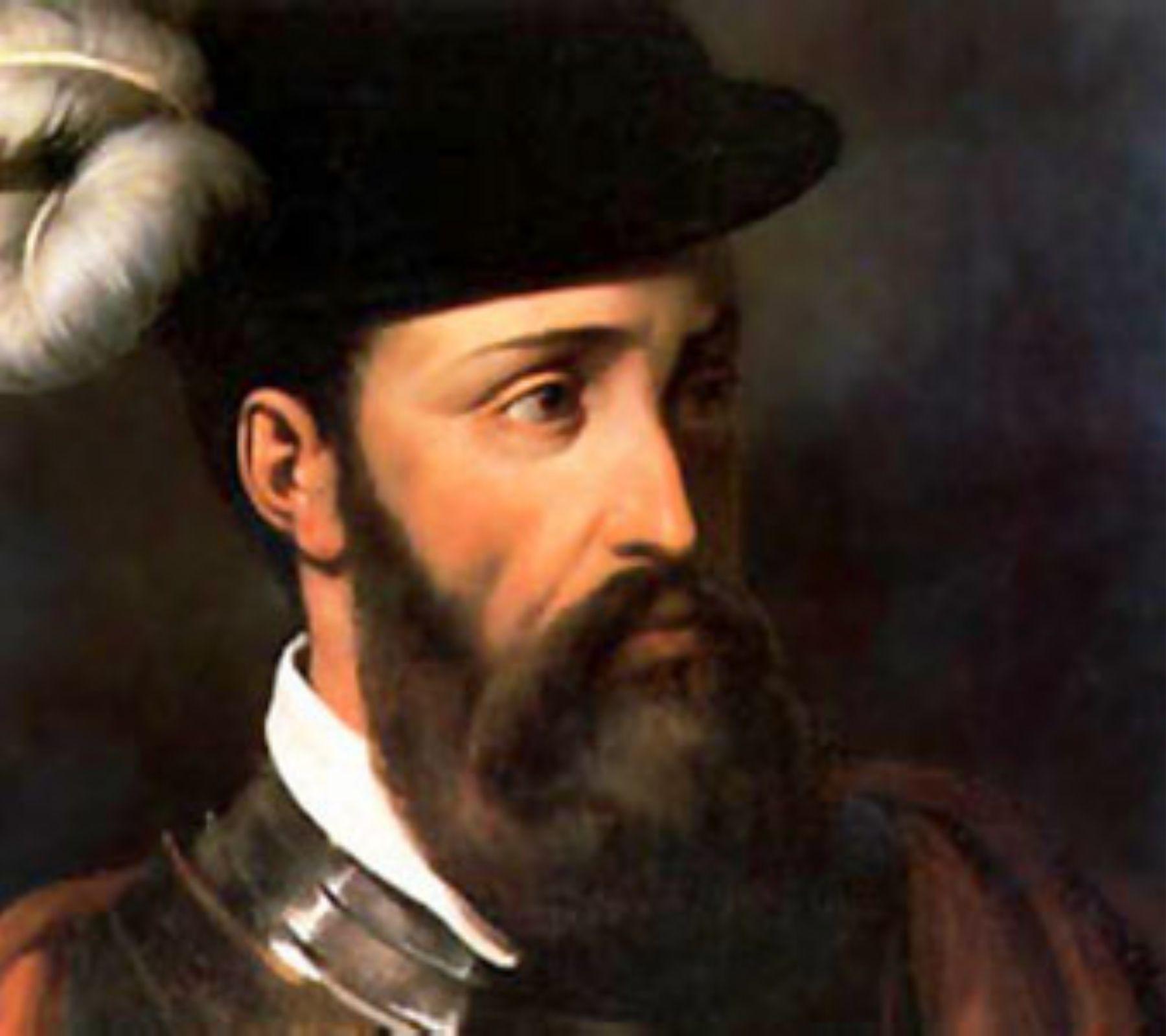
(Trujillo, Spain, 1478 - Lima, 1541) Conqueror of Peru. The decades following the discovery of America were dominated by the so-called conquistadors, Spanish military men who, sometimes with limited resources and a healthy dose of audacity and shrewdness, managed to seize vast territories. Such was the case of Hernán Cortés, the conqueror of Mexico, and Francisco Pizarro, conqueror of Peru, who in just three years (1531-1533) took control of the rich and powerful Inca Empire.
The illegitimate son of Captain Gonzalo Pizarro, from a young age he participated in local wars between chiefdoms and accompanied his father in the Italian Wars. In 1502, he embarked on the fleet that took Nicolás de Ovando, the new governor of Hispaniola, to the Indies.
A restless and strong-willed man, Francisco Pizarro struggled to adapt to the sedentary life of a colonist. This led him to join Alonso de Ojeda's expedition to explore Central America (1510) and later Vasco Núñez de Balboa's expedition to discover the Pacific Ocean (1513). Between 1519 and 1523, however, he settled in Panama City, where he served as councilman, encomendero, and mayor, positions that allowed him to amass a fortune.
The Conquest of Peru
Aware of rumors of great riches in the Inca Empire, he decided to combine his wealth with that of Diego de Almagro to finance two expeditions of conquest (1524-1525 and 1526-1528), both of which ended in failure. Due to the hardships suffered during the second attempt, Pizarro retreated to Gallo Island with twelve men, while Almagro went to Panama in search of reinforcements. The "Thirteen of Fame" took the opportunity to explore part of the west coast of South America, a region they named Peru, perhaps due to the proximity of the Virú River, and learned of the existence of a great civilization.
However, faced with the refusal of the governor of Panama to grant Almagro more men, in 1529 Pizarro traveled to Spain to present his plans to King Charles V, who, in the Capitulations of Toledo (July 26, 1529), appointed him governor, captain general, and adelantado of the new lands, a royal designation that provoked Almagro's resentment and frustration.
Upon returning to Panama (1530), Pizarro prepared a new expedition of conquest, and in January 1531 he embarked with a contingent of 180 men and 37 horses for Peru. Having learned of the war between the Inca emperor Atahualpa and his half-brother Huáscar, on November 16, 1532, the Spanish conquistador met with Atahualpa in the city of Cajamarca. After unsuccessfully urging him to embrace Christianity and submit to the authority of Charles V, he captured him in a bloody surprise attack.
The Inca agreed with the foreigners to fill a room with gold, silver, and precious stones in exchange for his freedom, but fulfilling his part of the pact proved futile. Pizarro, reinforced by Almagro's arrival at the head of a hundred arquebusiers, accused Atahualpa of ordering Huáscar's assassination from prison and of plotting a revolt against the Spanish. He ordered Atahualpa's execution, which was carried out on August 29, 1533. Pizarro then allied himself with the Inca nobility, allowing him to complete the conquest of Peru with virtually no resistance, beginning with Cuzco, the capital of the Empire (November 1533), and to crown Manco Cápac II, Huáscar's brother, as emperor.
Shortly afterward, Pizarro and Almagro became enemies over the possession of Cuzco. Although they initially joined forces to suppress the indigenous rebellion led by Manco Cápac II against Spanish rule (1536), they ultimately clashed openly at the Battle of Las Salinas in April 1538. Defeated and taken prisoner, Almagro was tried, condemned to death, and executed by Hernando Pizarro, the conquistador's brother (July 8, 1538). The revenge of Almagro's supporters, led by his son Diego de Almagro the Younger, came on June 26, 1541, when Pizarro was assassinated in his palace in Lima, the city he himself had founded on the banks of the Rímac River six years earlier.