Cusco is at 3,416 meters above sea level, and you can feel that from the moment you get off the plane. It has a high mountain climate characterized by being cool and having two clearly defined seasons: a dry season that goes from April to October, and a rainy season that dominates the territory from November to March.
Daytime temperatures rarely exceed 20°C, and in winter early mornings, especially in July, they can drop below zero without warning. Likewise, an important fact to consider is that, due to this extreme elevation, ultraviolet radiation hits with a very high intensity throughout the year, regardless of the feeling of cold in the environment.
On the other hand, as essential geographic context for your expedition, it is fundamental to understand that "Cusco" names both the vast Andean region and its capital, the ancient and legendary seat of the Inca Empire. In fact, this charming city located in the fertile highlands of the southern mountains not only represents a passing point, but also works as the starting point for travelers looking to conquer Machu Picchu and the vast network of tourist attractions; thus ensuring a logistical deployment that will require several days of immersion and continuous exploration on the ground.
What is the weather like in Cusco?
Cusco has a mountain climate, cool all year round, with an average temperature of 14°C. But the average number does not tell the whole story: what really defines the weather in Cusco is how unpredictable it can be. You can be under an intense sun and, minutes later, in the middle of a heavy rain; this is no accident: Cusco is located in a valley between mountains, where the cold air coming from the Pacific crashes with the humidity rising from the Amazon. That combination is what creates these very fast changes.
Throughout the year, the rainy season brings mostly cloudy skies, while the dry season offers more sun, although always with that cool background typical of the altitude. But there is something even more important that you must keep in mind before traveling: the temperature difference between day and night can be huge, up to 15 or 20 degrees in a matter of hours. It is common to go out with strong sun at noon and end the night with intense cold.
Because of this, there is a popular saying among locals in Cusco: "The climate of the Andes is as changing as the sky itself". Beyond the phrase, the idea is clear: if you are going to travel to Cusco, bring clothes that allow you to adapt to any scenario, because the weather rarely stays still for a long time.
What is the weather in Cusco?
The climate in Cusco is divided into two seasons: the rainy season and the dry season. In both, the mornings usually have a strong sun that asks for protection, but as soon as night falls, the cold arrives fast. So, no matter when you travel, you must be prepared for the changes.
The rainy season (November - March)
From November to March, Cusco enters its wettest time, with annual rainfall ranging from 500 to 1000 mm. Temperatures during the day are around 19°C to 21°C, while the nights almost never drop below 6°C in the city.
Something worth knowing: the rains do not arrive at just any time. They generally fall in the afternoons, which means that mornings are usually clear, ideal for making your visits and walks. In the afternoon, you can take shelter and watch how the city fills with rainbows, while Machu Picchu dresses in a deep green that is only seen at this time of the year.
However, keep in mind that the rains get stronger at the beginning of the year, and February is the month when the Inca Trail closes for maintenance, so if your plan includes that route, avoid those dates.
The dry season (April - October)
Between April and October, Cusco lives its driest time, with clear days and pleasant temperatures between 17°C and 19°C. The problem arrives when the sun hides: the nights become much colder.
In the city, early mornings can get close to 0°C, but if you are in a camp above 3,800 meters, temperatures drop several degrees more, especially in the middle of the year, in June and July. Added to this is the "cold wave", a typical freezing wind of this season that makes the cold feel even more intense than what the thermometer says.
This is also the high tourism season, so booking your train tickets, entrances to the citadels, and accommodation several months in advance is not optional, it is necessary if you do not want to run out of space.
What to bring according to the season?
To avoid bringing too much or too little, here is a quick comparison according to the time you travel:
| Equipment | Dry Season | Rainy Season |
|---|---|---|
| Base Clothing | Light thermal layers and breathable shirts for the strong daytime heat. | Quick-drying clothes that do not hold the moisture of the cloudy environment. |
| Defense against the Cold | High-density fleece or down jackets; thermal gear for below-zero temperatures. | Moderate coat (light fleece or sweater) for the cool city nights. |
| Weather Protection | Highly resistant windbreakers to neutralize the aggressive "cold wave". | 100% waterproof jacket or thick rain poncho. |
| Hiking Footwear | Standard trekking boots or approach shoes with a good grip. | Waterproof boots with deep traction to get through mud and slippery rock surfaces. |
| Critical Accessories | Glasses with UV filter, wide-brimmed hat, extreme sunscreen, and lip balm. | Compact umbrella, waterproof backpack cover, sunglasses, and mosquito repellent. |
What is the temperature like in Cusco?
On average, Cusco has highs of around 20°C and lows close to 9°C. The warmest month is October, when the temperature can reach up to 21.7°C. On the other end is July, the coldest month, with lows that can drop to -1.6°C.
It is important to put that fact in context: that below-zero cold happens during the nights and early mornings inside the city. If your trip includes sleeping in high mountain areas or near high passes, the cold will be much more intense, so you will need really good thermal clothes for those nights.
As for the rains, January is the most intense month of the year, with an average of 156 mm per month. It is a high number, so if you travel on those dates, always keep something waterproof at hand, because the rains can fall suddenly and with force.
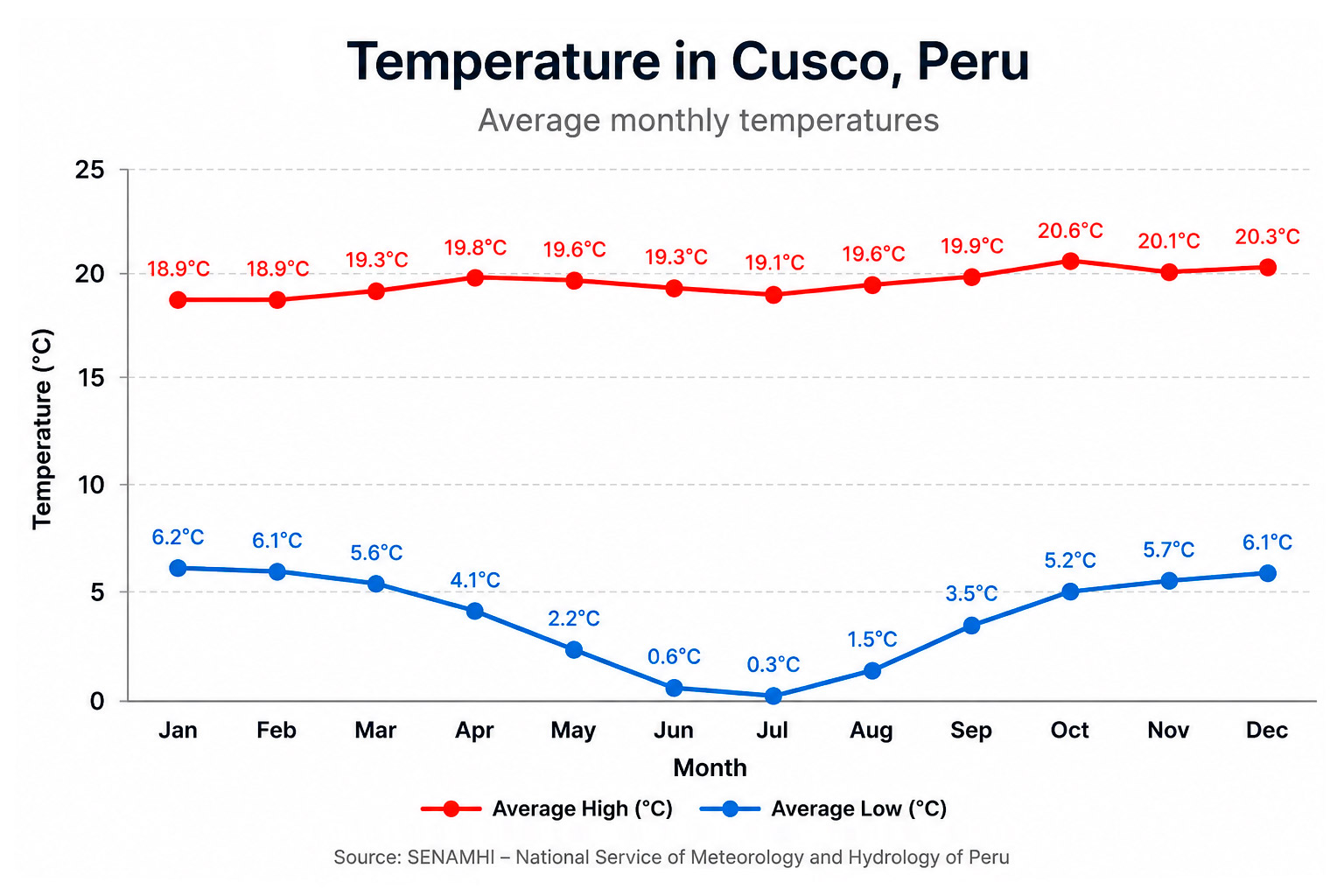
The weather in Cusco, month by month
The weather in Cusco always has some variability, so it is good to know what to expect before traveling. The nights are cold all year round, and interestingly, in the dry season that cold is felt even with the sun shining right at you. On the other hand, during the rainy season, the environment becomes a bit warmer and more humid. The annual average temperature is 14°C, with a base rainfall of 517 mm. Here is a month-by-month summary so you can plan your trip better:
The Weather in Cusco in January
Starting the cycle, January marks the peak of the rainy season, making the city an ideal setting for travelers who seek to explore with fewer tourists and want to live the Carnivals up close. In fact, since the rains are intense, it is worth bringing good waterproof gear.
- Maximum / minimum temperature: 19 °C / 6 °C
- Total rainfall: 103 mm (23 rainy days, 8 dry days)
- Hours of sun: 11 hours
The Weather in Cusco in February
Moving forward on the route, February keeps a high level of humidity and mostly cloudy skies. Something important to keep in mind is that this is the month when the Inca Trail closes for maintenance. Of course, the city makes up for it with the colorful Carnivals.
- Maximum / minimum temperature: 19 °C / 6 °C
- Total rainfall: 90 mm (23 rainy days, 4 dry days)
- Hours of sun: 10 hours
The Weather in Cusco in March
Later, March presents itself as an excellent transition window toward the dry season. The rains start to decrease and the Andean landscape looks its greenest, ideal if you like photography or walking on clearer paths.
- Maximum / minimum temperature: 19 °C / 5 °C
- Total rainfall: 70 mm (23 rainy days, 6 dry days)
- Hours of sun: 10 hours
The Weather in Cusco in April
On the other hand, April confirms the climate change. Also, it is a strategic month to visit the territory without the stress of the high season crowds, offering a very mild climate that usually coincides with the cultural passion of the Cusco Holy Week.
- Maximum / minimum temperature: 20 °C / 4 °C
- Total rainfall: 36 mm (18 rainy days, 11 dry days)
- Hours of sun: 9 hours
The Weather in Cusco in May
Next, the month of May officially starts the high season. During this phase, the skies clear up almost completely, and this month usually matches the mystical "Qoyllur Riti" festival in the heights.
- Maximum / minimum temperature: 20 °C / 3 °C
- Total rainfall: 17 mm (11 rainy days, 19 dry days)
- Sunshine hours: 9 hours
The Weather in Cusco in June
June is one of the driest months of the year in Cusco, and it also marks the start of the most intense cold. During the day the sky is usually between partly cloudy and clear, but the nights are quite freezing, so do not be surprised if you need several layers of clothing as soon as the sun goes down.
- Maximum/minimum temperature: 13°C / 2°C
- Total precipitation: 6 mm (4 days of rain, 25 dry days)
- Hours of sun: 7 hours
The Weather in Cusco in July
Entering the core of winter, July is crowned as the driest and at the same time the coldest month of the year. Since it is high season, it is key to book your Machu Picchu tickets several months in advance if you do not want to be left without a spot.
- Maximum / minimum temperature: 20 °C / 0 °C
- Total rainfall: 8 mm (6 rainy days, 23 dry days)
- Sunshine hours: 8 hours
The Weather in Cusco in August
Continuing with the winter display, August keeps the dry weather, with good visibility for those who enjoy trekking. However, get ready for the "friaje", those cold Andean winds that make the temperature feel lower than the thermometer shows.
- Maximum / minimum temperature: 20 °C / 2 °C
- Total rainfall: 11 mm (7 rainy days, 23 dry days)
- Sunshine hours: 9 hours
The Weather in Cusco in September
In the final stretch of the year, September works as a new transition window, this time announcing the slow return of the rains. The advantage is that there are fewer tourists, which means more peace in the archaeological sites and better prices.
- Maximum / minimum temperature: 21 °C / 4 °C
- Total rainfall: 17 mm (12 rainy days, 18 dry days)
- Sunshine hours: 10 hours
The Weather in Cusco in October
Further on, October stands as the warmest month of the Andean calendar. The rains begin to appear more often, and the mountains around Cusco start to turn green again after winter.
- Maximum / minimum temperature: 21 °C / 6 °C
- Total rainfall: 52 mm (19 rainy days, 12 dry days)
- Sunshine hours: 10 hours
The Weather in Cusco in November
Progressively, November secures the wet front, presenting frequent rains but accompanied by a very pleasant and mild temperature. It is a month with good energy in the city, right before the strongest storms of the year arrive.
- Maximum / minimum temperature: 21 °C / 7 °C
- Total rainfall: 64 mm (21 rainy days, 9 dry days)
- Sunshine hours: 10 hours
The Weather in Cusco in December
Finally, December closes the operational cycle wrapped in thick clouds and heavy rains. Even so, the city fills with life thanks to craft fairs like the "Santurantikuy" and the Christmas and New Year celebrations in the main square.
- Maximum / minimum temperature: 20 °C / 7 °C
- Total rainfall: 114 mm (21 rainy days, 10 dry days)
- Sunshine hours: 9 hours
When to go to Cusco?
The best time to travel to Cusco depends a lot on what kind of experience you are looking for. If your priority is doing outdoor activities and having the best views of Machu Picchu, the ideal months are between late April and June, and then again from early July to late September. If instead you prefer a slightly warmer and milder climate, it is best to travel between late October and mid-November.
If your plan is to do a multi-day trek, this is what you should know: the best season for the Inca Trail goes from May to September, while the Salkantay offers good conditions from May to October. An important fact you should not forget: the Inca Trail closes all of February for maintenance, so, if your trip falls on those dates, you will need an alternative plan.
It is also necessary to keep in mind that the high tourism season goes from the middle of the year to August. This means that train tickets, Inca Trail permits, and Machu Picchu tickets sell out well in advance, up to six months before in some cases. If you are going to travel on those dates, it is worth booking everything with time to avoid running out of space.
To make the decision easier, here you have a quick comparison with the pros and cons of each season:
| Season | Tactical Advantages | Logistical Challenges |
|---|---|---|
| High Season (May to October) | Clear skies that guarantee perfect visibility. Dry and firm trails, ideal for trekking. Maximum cultural excitement and festivals in the middle of the year. | Massive crowding in archaeological sites. Obligation to book permits and hotels months in advance. Truly freezing mountain nights. |
| Low Season (November to April) | Clear territory with a very low density of tourists. Accommodation and service rates notably lower. Andean landscapes covered in an intense and unreal green. | Frequent and intense rain, especially in the afternoons. Definitive closure of the Inca Trail in February. Slippery trails that require more technique. |
Extra tips about the weather in Cusco
Beyond the obvious, there are some details of the Andean weather that you should keep very clear before traveling. Here we leave you the most important ones:
- The sun hits harder than it seems: Above 3,350 meters, the atmosphere filters much less solar radiation. That means you need sunscreen of at least SPF 50, and if you are going to go up above 3,000 meters often, the ideal is to use one of SPF 70 or more.
- Always carry a waterproof jacket: The weather in the mountain range can change from one moment to another, almost without warning. For that reason, never go out for a walk or a tour without a waterproof jacket in your backpack. Even if the day starts sunny, that can change in minutes.
- The cold feels stronger than what the thermometer says: At this altitude, the combination of elevation and wind makes the real feel much lower than the actual temperature. A day of 10°C can feel like it is at 0°C, so do not trust only what the forecast says.
- Watch out for the "cold wave": If you travel between July and August, you will notice cold winds coming from the south that lower the sensitive temperature even more. For those days, it is a good idea to bring an outer layer that cuts the wind well.
- The altitude dehydrates you faster than normal: The dry and cold air of the heights makes your body lose liquids faster, often without you noticing. Because of this, it is important to drink more water than usual and bring a good moisturizing lip balm and cream, because the skin dries and cracks easily in these conditions.
- The nights are cold no matter the season: It does not matter what month you travel: when the sun goes down, the cold arrives and stays. Therefore, it is a good idea to always bring thermal clothes, even to sleep.
- The cold can make altitude sickness worse: Altitude sickness and cold weather are quite related. If you arrive in Cusco during the coldest months, the symptoms of altitude sickness can be felt with more intensity. Therefore, keeping yourself warm from the first day is key: your body already has enough work adapting to the altitude to also have to deal with the cold.
Questions and answers about the weather in Cusco
- What is the weather like in Cusco?
The climate in the city of Cusco is relatively mild, with cold nights and sunny days. The weather is very changeable: it can go from bright sunshine to torrential rain in just minutes. During the day temperatures normally range between 13ºC. (55.4ºF) and 15ºC. (59ºF). - What is the weather like in Machu Picchu?
Machu Picchu has a warmer climate compared to the city of Cusco. The maximum temperature can reach 25ºC. (77ºF). The minimum temperature can drop to 8ºC. (46.4ºF). - When does the rain start in Cusco?
The rainy season begins in December. However, the heaviest rains occur in January, February and March. - When does it rain the least in Cusco?
Cusco has night temperatures ranging from 8ºC. to a minimum of 0ºC. June, July and August have the coldest night temperatures. - Is it very cold in Cusco?
Cusco has night temperatures ranging from 8ºC to a minimum of 0ºC. June, July and August have the coldest night temperatures. - What is the maximum temperature in Cusco?
During the day Cusco can record maximum temperatures of up to 23ºC. - What is the weather like on the 7-color mountain?
The 7-color mountain (Vinicunca) has temperatures that vary from a maximum of 14ºC to a minimum of -10ºC (at night). - What is the weather like in the Sacred Valley of the Incas?
The weather in the Sacred Valley of the Incas varies depending on the town and its altitude. In general it ranges from a maximum of 23ºC to a minimum of -2ºC at night. - What clothes should I bring on my trip to Cusco?
When traveling to Cusco, it is recommended to bring light clothing for the day (with a windbreaker jacket) as well as warm clothing for the evening. Don't forget to bring thick socks, a windbreaker jacket, sports pants, ponchos, chullos and gloves. - What is the month with the best weather in Cusco?
For tourism in Cusco, the best weather is May, June and July because it does not rain frequently during these months. This is ideal for hiking as well as visiting different archaeological sites outdoors.