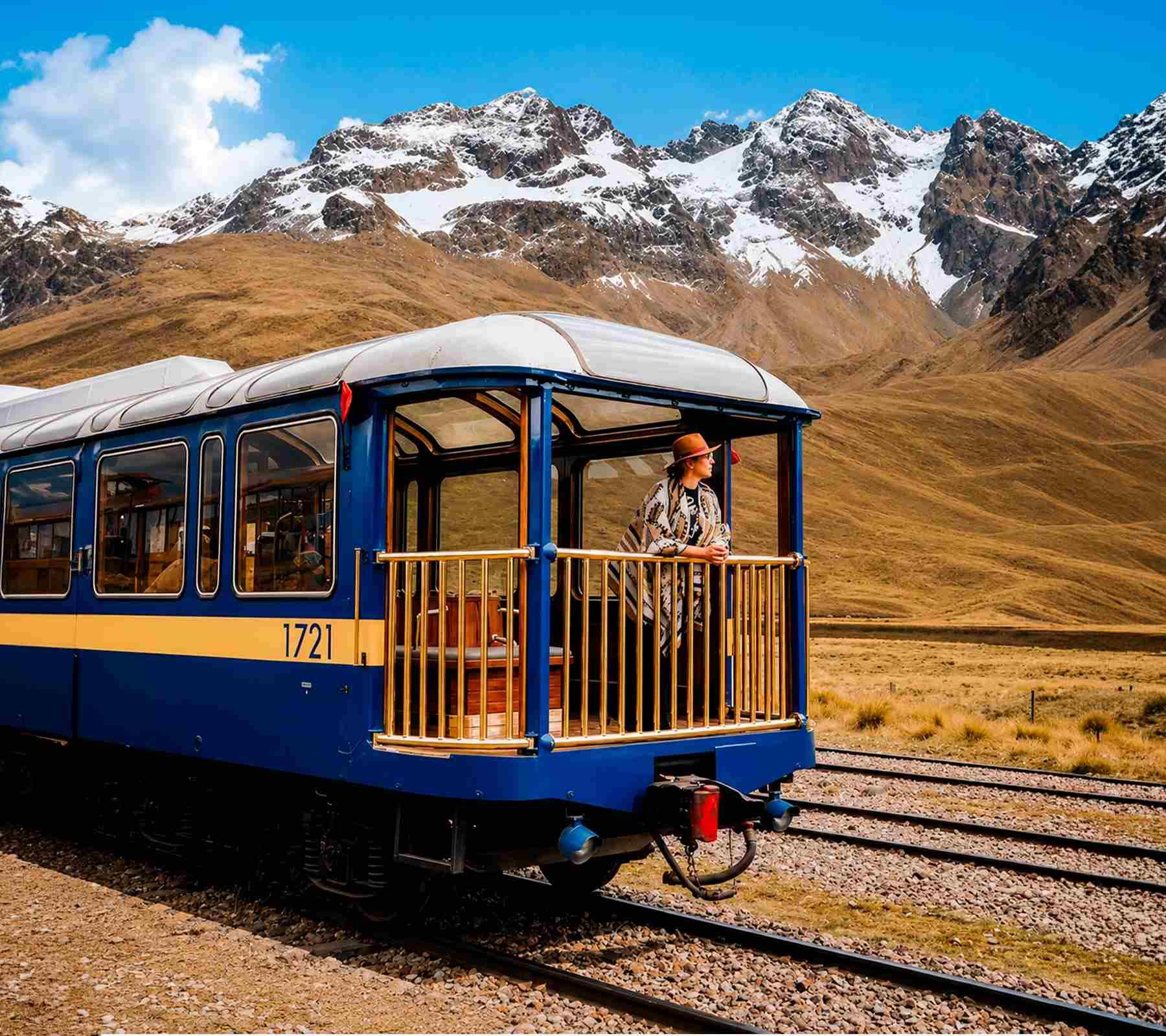
The train trip from Cusco to Puno is one of the most comfortable and scenic ways to cross the Peruvian highlands. Aboard the PeruRail Titicaca, you will travel for about 10 and a half hours through Andean landscapes, from the valleys near Cusco to the shores of Lake Titicaca, with stops, food, and live music included on the way.
Unlike other land routes, this train crosses the highest point of its trip at La Raya, at 4,335 meters above sea level, before going down to Puno. The service mixes Pullman-style comfort with a cultural experience on board: typical dances from Cusco and Puno, a pisco sour class and a three-course gourmet lunch made with local ingredients.
In this guide, you will find everything you need to plan your trip: departure times, prices, what to bring with you, the difference between traveling from Cusco to Puno or from Puno to Cusco, and if the train or the bus is better depending on your itinerary.
General trip details
- Length and departure times
The train trip from Cusco to Puno takes about 10 hours and 30 minutes. The PeruRail Titicaca leaves on Wednesdays, Fridays, and Sundays, so it is a good idea to plan the itinerary in advance if your travel date does not match these days. We recommend booking 1 to 2 months in advance, especially in the high season (June and August), when departures usually sell out weeks in advance. - Boarding points (Wanchaq station, Cusco / Puno station)
We recommend arriving at the station at least 30 minutes early for the check-in and boarding process.- From Cusco: Boarding is at the Wanchaq station, located just 10 minutes from the Main Square (Av. Pachacuteq s/n, Wanchaq).
- From Puno: The boarding point is at 224 La Torre Ave.
- Prices and allowed luggage
The price of the PeruRail Titicaca train usually stays between $290 and $390 per person, for a one-way trip (remember that it is a one-way service, not round trip). The exact rate depends on the season, how early you buy, and the active deals at the time of booking. We recommend checking the updated price right on the official PeruRail website before booking.
As for luggage, each passenger can bring 1 backpack of 8kg + 1 suitcase with a combined weight of up to 23 kg. It is recommended to travel with light luggage, since the storage space on board is limited.
Route from Cusco to Puno
Before boarding, you can enjoy hot drinks at the Wanchaq station in Cusco, a useful break to get used to the altitude before starting the trip. The PeruRail team welcomes you and goes with you during boarding, guiding you to your seat to begin crossing the Andes.
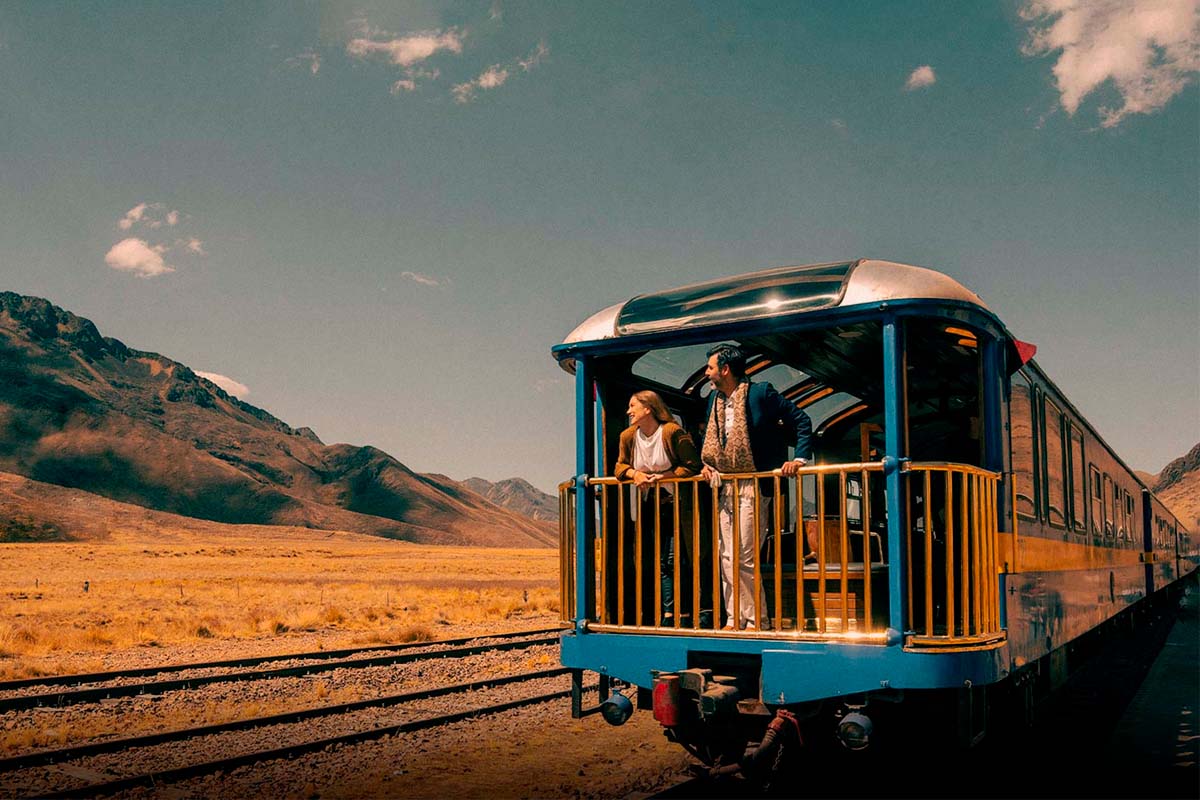
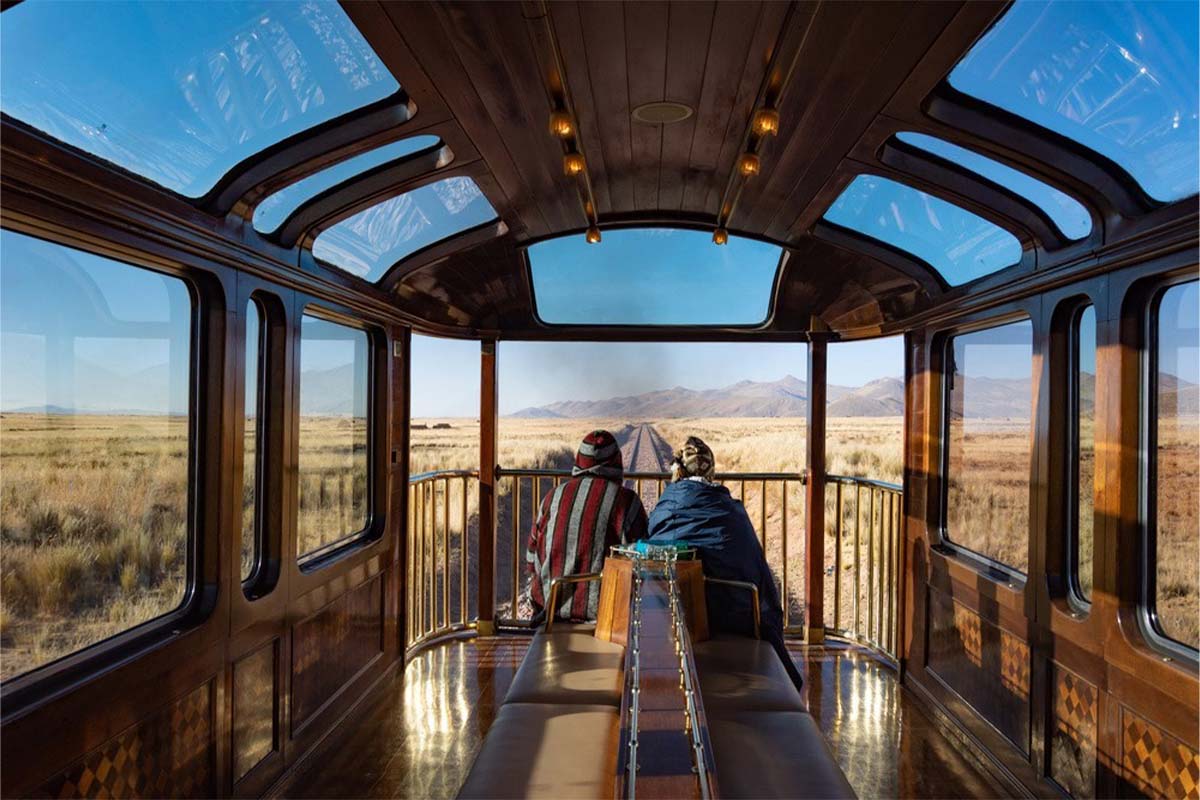
Once on the way, the Observatory bar car welcomes passengers with a free drink, live music, and the show of three traditional dances from Cusco. Added to this is an exclusive fashion show of baby alpaca clothes, which combines tradition and Andean fashion. Also, the train takes a break in the town of La Raya, the highest point of the route, where passengers can enjoy wide views and meet local craftspeople who offer traditional pieces as a memory of the trip.
During the trip, a three-course gourmet lunch with local ingredients is served, followed by an interactive class to learn how to make pisco sour. Later, a show of traditional dances from the Puno region, accompanied by live music, closes the cultural part of the trip. Before arriving, afternoon tea with cakes and sweet snacks is offered.
The trip ends at the Puno station, located less than 10 minutes from Lake Titicaca, the highest navigable lake in the world.
About the Stop at La Raya: the highest point of the route
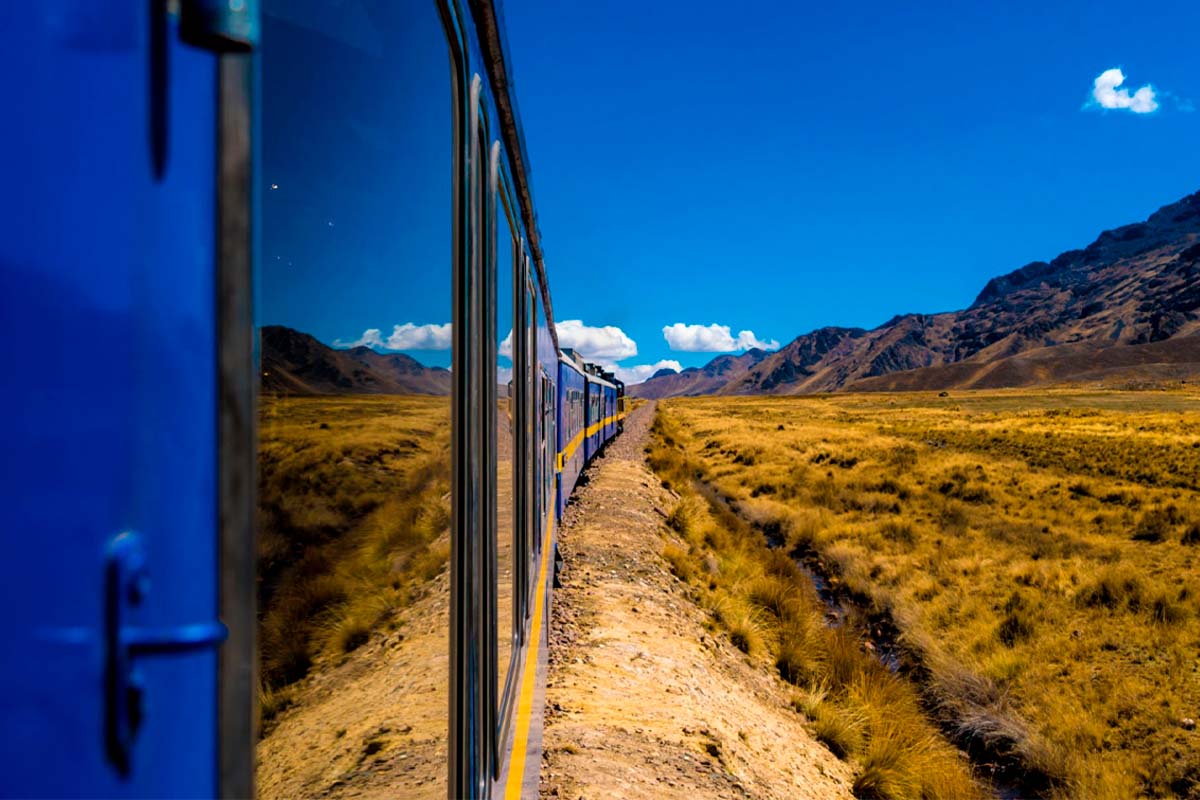
La Raya marks the highest point of the whole route between Cusco and Puno, at 4,335 meters above sea level. Here the landscape changes a lot: the plants become fewer, the sky feels closer, and the view opens up to the mountain range that separates both regions. It is one of the most photographed moments of the trip, both for the height and for the wide space of the high plateau landscape.
During the short break, local people offer handmade traditional crafts, like woven items and pieces made of alpaca wool. It is a good time to stretch your legs, take photos, and, if you want, take a memory directly from the local craftspeople before continuing the way down to Puno.
Food and experiences on board
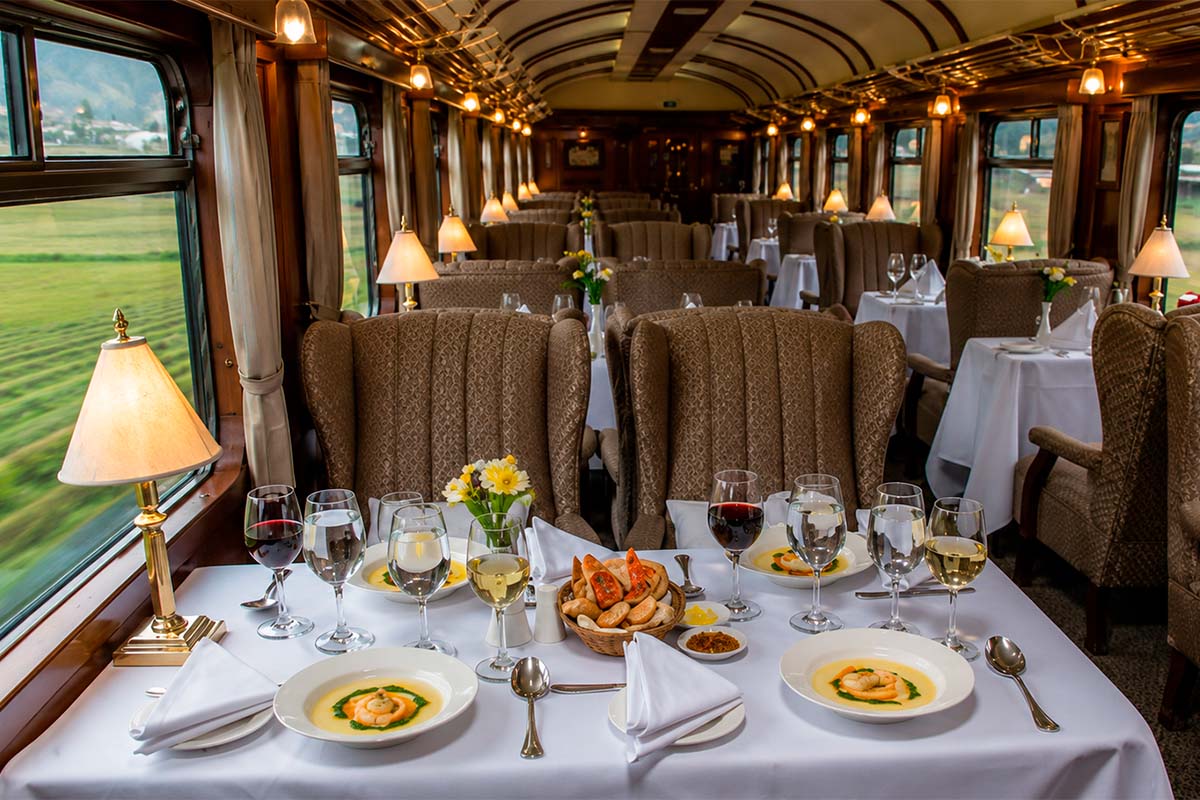
On board the train, a three-course gourmet lunch is served, prepared with local ingredients and presented with the same care you would find in a top-level restaurant. The food menu seeks to reflect typical flavors of Peruvian cuisine while you enjoy the views of the Andes from your seat.
Also, as part of the cultural experience, passengers can take part in an interactive class guided by expert bartenders, where they will learn how to prepare the pisco sour, one of the most representative cocktails of Peru. It is a practical activity that breaks the pace of the trip and adds a learning part to the experience.
Towards the end of the trip, an afternoon tea is served with a selection of cakes and sweet bites, designed as a relaxed closing before arriving in Puno.
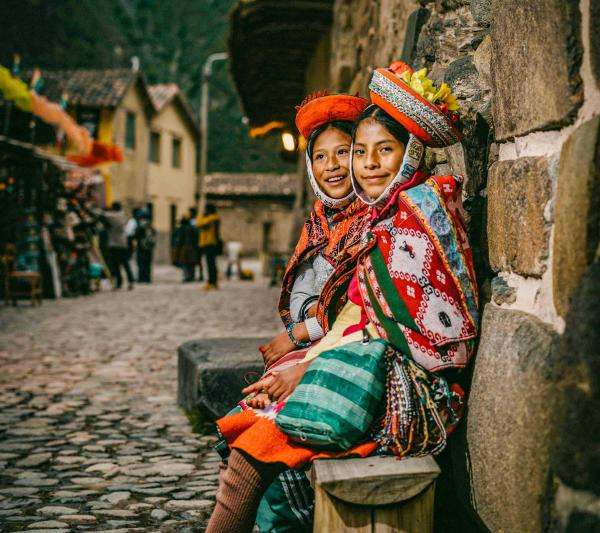
The cultural part is present at several moments of the tour, with presentations of traditional dances from both Cusco and the Puno region, accompanied by live music. These shows seek to reflect the diversity of traditions that connect both regions along the route.
Cusco-Puno vs Puno-Cusco route: Differences
The PeruRail Titicaca train operates in both directions, but on different days depending on the direction:
- Cusco → Puno: It leaves on Wednesdays, Fridays, and Sundays, boarding at the Wanchaq station (Pachacuteq Ave. s/n, Cusco).
- Puno → Cusco: It leaves on Mondays, Thursdays, and Saturdays, boarding at the Puno station (224 La Torre Ave.).
In both directions, the trip takes about 10 hours and 30 minutes, and the allowed luggage is the same: 1 backpack of 8 kg + 1 checked bag of 23 kg. Before your trip, always check the current schedules on the official PeruRail website, as they can be updated by season.
What changes in the itinerary depending on the direction of the trip
The experience on board is practically the same in both directions (gourmet lunch, pisco sour class, baby alpaca clothing fashion show, dances from Cusco and Puno, stop at La Raya and afternoon tea), but there are some specific differences:
- Welcome drink before boarding: Those leaving from Cusco enjoy hot drinks at the Wanchaq station; those leaving from Puno, at the Puno station.
- Order of the typical dances: In both directions, the welcome show on board opens with dances from Cusco, and the live music from the Puno region arrives later in the tour, so this order does not change depending on the direction of the trip.
- Final arrival point: Those traveling to Puno arrive at a station located minutes from Lake Titicaca; those traveling to Cusco arrive at the Wanchaq station, just 10 minutes from the Main Square.
- Available days to build the itinerary: Since each leg operates on different days (Wednesdays/Fridays/Sundays to Puno vs. Mondays/Thursdays/Saturdays to Cusco), it is key to organize the rest of the trip (Machu Picchu, Sacred Valley, tours in Puno) based on these fixed days.
Train vs. bus: which one to choose?
PRICE AND DURATION COMPARISON
| Titicaca Train | Direct bus | Tourist bus (Route of the Sun) | |
|---|---|---|---|
| Approx. price | $290 – $390 | $30 – $35 | $45 |
| Duration | 10h 30min | 7 – 8 hours | 10 hours |
| Stops | La Raya | No tourist stops | Andahuaylillas, Raqchi, Pucara and La Raya |
The direct bus is the cheapest and fastest option if your priority is simply getting from one point to another. The tourist bus (Route of the Sun) is closer to the train in duration, as it includes stops and guided tours along the way, but at a fraction of the price. The train, on the other hand, is designed as an experience in itself rather than as a means of transport.
Comfort and experience comparison
The PeruRail Titicaca train offers a much higher level of comfort: Pullman-style seats, an observatory-bar car, a three-course gourmet lunch, a pisco sour class, and live shows during the whole trip. It is the right option if you want the trip itself to be part of the tourist tour, with photos and a premium level service.
The tourist bus, for its part, also includes lunch and a guide, but with a focus that is more informative than entertaining, and with stops at archaeological sites like Raqchi and the Pucara lithic museum that the train does not visit. The direct bus prioritizes speed over experience: with no tourist stops or onboard services beyond basic drinks and snacks.
In short, if your budget is limited or time is pressing, the direct bus is the best option; if you want to see archaeological sites along the way without spending as much as on the train, the tourist bus is a good middle ground; and if you are looking for a luxury experience as part of your trip to Puno, the train is the natural choice.
What to bring and recommendations
-
Clothes and weather at high altitude
During the trip you will cross different ecological zones, from mild valleys to the La Raya pass, so the weather can change a lot. The most practical thing is to dress in layers: a light base piece, a mid-layer coat, and a windbreaker jacket. A hat, gloves, and sunscreen are also recommended, since solar radiation is stronger at this altitude even with low temperatures. -
Altitude sickness prevention
Since the trip reaches 4,335 m.a.s.l., it is normal to feel mild symptoms of soroche (altitude sickness), like a headache or tiredness. To lower the risk, it is recommended to arrive in Cusco or Puno at least one day in advance to get used to the altitude before the trip, stay well hydrated, and avoid drinking alcohol. Coca tea, available at several stops and stations, is a traditional option that many travelers use to help get used to the altitude. -
Documents and check-in
To board you need your original identity document or passport, the same one you used to make the booking, since PeruRail asks for this check at the time of boarding. It is recommended to arrive at the station at least 30 minutes before the departure time to complete the check-in process without problems. It is also useful to have your booking receipt on hand, either printed or on your cell phone.
Frequently asked questions
- How long does the train trip from Cusco to Puno take?
The trip takes about 10 hours and 30 minutes, both in the Cusco-Puno and Puno-Cusco directions. - What days does the PeruRail Titicaca train run?
It depends on the direction: the Cusco → Puno route leaves on Wednesdays, Fridays, and Sundays, while the Puno → Cusco route leaves on Mondays, Thursdays, and Saturdays. - How much does the train from Cusco to Puno cost?
The price usually stays between $290 and $390 per person, for a one-way trip. The exact rate changes depending on the season and how early you buy it, so it is recommended to check it on the official PeruRail website. - Where do you board the train in each city?
In Cusco, boarding is at the Wanchaq station (Av. Pachacuteq s/n). In Puno, at Av. La Torre 224. - How much luggage can I bring?
Each passenger can bring 1 backpack of 8 kg and 1 checked bag of 23 kg. - Does the train make stops during the trip?
Yes, the main stop is in the town of La Raya, the highest point of the route at 4,335 m.a.s.l., where you can see local crafts and take panoramic photos. - What does the train ticket include?
It includes a welcome drink, a three-course gourmet lunch, an interactive pisco sour class, typical dance shows from Cusco and Puno, and afternoon tea. - Is it better to travel by train or by bus from Cusco to Puno?
It depends on your priority: the direct bus is cheaper and faster (7-8 hours), the tourist bus includes archaeological stops at a lower price than the train, and the train offers the most comfortable and exclusive experience of the trip. - Is it necessary to get used to the altitude before the trip?
Yes, it is recommended to arrive in Cusco or Puno at least one day early before taking the train, since the trip crosses 4,335 m.a.s.l. and can cause mild symptoms of soroche. - What documents do I need to board?
Your original identity document or passport, the same one you used to make the booking.